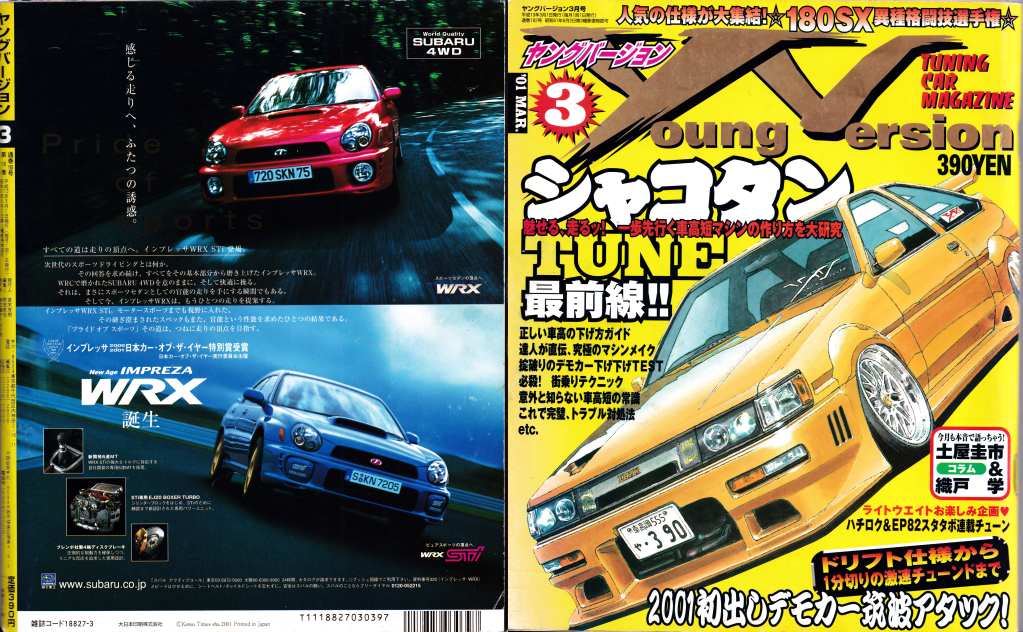
While most are probably familiar with Drift Tengoku or Battle Magazine, the late 90s/early 2000s had a huge selection of Japanese tuning magazines.
The hobby was definitely at its all time peak popularity, and that was clearly seen through the number of niche magazines for every type of enthusiast.
Young Version was actually one of the earliest car tuning magazines in conjunction with Option. It was published from 1987 to 2005.
I was able to come across an article from an old writer/editor for the magazine (link at the end). According to them, the magazine’s key characteristic was the large teenage readership. Due to the beginner friendly themes and topics, Q&As, and DIY articles, it was popular among high schoolers who just got their first cars or were planning on it.
I only own a few issues of these. They don’t pop up too often, but I also haven’t gone out of my way to get them. This one, however, was a must have; you’ll soon know why!
Trust full spread ad

As usual, every magazine has to start off with a full spread ad; usually, this spot is always reserved for the heavy hitters.
Bride, Rays, Yokohama, etc.
On this one, we got a super cool Trust ad. If you know anything about Japanese cars, you definitely know GReddy, but GReddy is actually a subbrand for Trust, the main brand. Trust had a few subbrands, each with their own type of products.
GREX was the drivetrain and suspension brand. Parts like engine internals, brake systems, and transmission gear sets were advertised and sold under that name. Secondly is Gracer, which was the aero subsidiary, from lip kits to full on body kits for lots of different models all under that name. Lastly was GReddy, which was mostly for turbo/turbo related parts and cooling components.
Parts such as turbo timers, gauges, and spark plugs were also under that name brand. However, the fluids such as engine oil and brake fluid were sold under the Trust name, using a different logo.
The reason the GReddy name became more popular to people outside Japan was due to Trust’s interest in entering the American market back in the early 2000s. When they decided to open up shop in the US, the name Trust was already taken by a shop in the automotive sector. And so they had to pick something else; they went with the second most recognizable sub brand of theirs, which was GReddy. Due to the huge influence they had on the US tuning scene, the name GReddy slowly became more popular than the original Trust name, and that’s what most people think of nowadays when they think of the brand.
With time, they leaned towards that and would slowly adapt the GReddy name to most of their parts catalog ,stopping the usage of the name Gracer, and only reserve GREX for a few specific parts such as the oil cooler blocks.

The clear plastic electronics are a staple of the early 2000s, GReddy at the time was making turbo timers and boost controllers in clear blue and pink.
One of my favorite parts from that time, I have two clear blue turbo times. One brand new in box, and another used one that I plan on putting in my car.
Here are some better pictures of them.


Another favorite of mine are the gauges, they came in black and white (and a limited silver version) with green back lighting.
These are the early Data Link models, where each gauge had a separate controller. Lateer on they’d get revised into a single controller. That version is called SMI. I have a few of each I plan on using in my car as well.
Bride Holding Monster ad

I’ve somehow managed to not talk about Bride seats in these magazine coverages yet!
Bride is another one of those that needs a full blog post on its own. Calling me a Bride enthusiast is an understatement; I think the word fanatic might be more accurate. I haven’t owned too many Bride seats over the last few years that I’ve started collecting them. But I am, however, very interested in the history, the heritage, and all the different seats throughout the years.
I even made an archive page for them! I admit it’s not as high effort as the Break Ito 180sx one, but I try to keep it informative. With the death of Zilvia, a great source of info, “The Ultimate Bride Seat Thread” was lost. So I will eventually try and make a new one on here. One that I can update over time whenever I get new scans and/or information regarding the long list of seats made and the brand in general.

This specific 2001 ad features the recliner seat line up, usually referred to as the “1.5” seats. These recliners were available from 1997-2002, and 2005-2009*. More on that at a later date.
From left to right, we got the Brix, which is the most aggressive in terms of bolstering. A popular seat among drifters and hardcore street racers. Then the Ergo, a less aggressive but still sporty recliner. The Xax is a mash up of the Ergo’s sporty upper, but with a more easy to get into bottom half taken from the Revs, which was the least aggressive recliner Bride seat as can be seen in the far right.

Back then, to get a full catalog of the seat line up, all you had to do was send in an envelope with the required stamps, and Tee’s Corp (company in charge of Bride) would mail you back one of their current catalogs with all the necessary info you need to make your seat purchase. I have been looking tirelessly for one of these ’97-’02 catalogs but am yet to find one. But when I do, I’ll make sure to share all the contents of it with you all.
2001 Osaka Automesse ad

Osaka Autemesse is one of the biggest shows that take place once a year in Japan. It’s only a few weeks after Tokyo Auto Salon so most companies participate in both to gather a larger audience from two of Japan’s biggest regions.
Shakotan Tuning Guide

The early 2000s had a huge surge of low car popularity, lowering sport cars from their normal factory height was always a common modification. But from late 99 onwards, enthusiasts really started to push the boundaries of how low a car can be while still performing well.
Professional drift cars reached their peak coolness (IMO) in 2001 with how low and aggressive their stance was. It’s obvious now that minimal ground clearance and limited suspension travel isn’t what you want in a competitive drift car. But back then, they simply didn’t care too much about that stuff and cared more about having a cool looking drift car!
The low car trend never died, of course, but it did split into a few different crowds after that period. The low height became more of a novelty than an essential part of a drift car; the low cars got lower… much lower. And the pro cars got taller and more advanced in terms of suspension tuning.
But for a brief period in time, the lowest cars were also some of the fastest and best performing in D1 and other national drift events, and that’s something that’ll probably never be the case again.
Low Ride Hight Coolness Check in Three Stages

“Ever since the time of the older generation, the association that ‘tuned cars = having low ground clearance’ has been a widespread belief.
Why is this? Simply because it looks cool! Of course, as a racer, performance is equally important as aesthetics. However, when you consider it objectively, to navigate corners swiftly and maintain a stable posture, it’s crucial to stiffen the suspension and reduce roll (lower the car’s height). You can observe this in racing cars that prioritize speed. What am I trying to convey? Essentially, I’m saying, ‘fast cars are low and cool,’ or rather, ‘low cars are fast and cool!’ So, I decided to conduct an experiment to observe how much the perception of a car’s appearance changes simply by altering its height.”

Stock ride hight: F=618mm/R=624mm
“Why is it that Japanese cars, not just the Civic, have so much space between the fender and the tire? Even though foreign cars (like BMWs) don’t have this much space in the stock condition. Apparently this is because of various restrictions, such as not wanting to interfere when winding snow tire chains. No matter how cool a car is, it’s ruined if it’s like this!”
Recommend ride hight for JTC Coilovers: F=596mm/R=604mm
“It’s just the right amount of lowering. It still rides comfortably on the street. I’d say this is the bare minimum for what I like”
“Compared to other models (Silvia/180SX, etc.), the Civic’s suspension, doesn’t have as substantial of a drop when installing the Coilovers right out of the box. But it does still make a huge impact on appearance. Compared to the stock car height + aero, it gives the car a more cohesive look overall, which is great!!”
Maximum lowered hight: F=572mm/R=579mm
“A total of 45mm lower from stock, giving the car a show like appearance that’s dazzling!”
“This is what it looks like when you lower it to the limit while still keeping it drivable! The gap in the arch, which was so big you could fit your fist in it with the stock suspension, has been completely eliminated! In fact, you can’t even fit a finger. Setting aside the question of whether it’s suitable for riding around town (!?), it’s undoubtedly the best looking version. Even when it’s parked, it exudes an aura of something extraordinary!!”
Low Car Secrets:Kazama’s S15

“Start off with choosing the wheels you want to run, then setup the ride hight!”
“If this machine was ever in a cool car competition, it’s undoubtedly getting one of the top spots. The Kazama S15 has an overwhelming presence, thanks to lots of effort and unique little tricks you can see everywhere. Master Kazama, who is very particular about looks, will teach us how to make a low, cool, and fast moving machine!”

“The details that make this machine really stand out”
“Aside from the basics of aero and a low ride hight, there are some neat little touches that will be obvious to anyone who pays attention! First of all, the rear spoiler. It wasn’t just replaced from the original, it was moved back from the factory position by 2cm! To do this, the original hole was filled in and a new holes drilled instead. Furthermore, the part where the trunk key is inserted has also been smoothed out on the trunk. And the sunroof visor has been replaced with the original one from a JZZ30 Soarer. There’s no doubt that these little touches, which only owners and car enthusiasts will understand, contribute to this car’s enchanting aura! Also, depending on the wheel, the car’s stance changes ‘with this specification, 17-inch wheels look cooler with a forward rake, while 18-inch wheels look cooler with a backward rake.’”

“The tires not only fill the gap at the top, but also align with the cars shape side to side!”
“The attention to detail when it comes to low riding and fitment is extraordinary! For example, the car’s height should be such that the fenders slightly overlap the shoulders of the tires (tucking just the edge of the tire). It’s no good if it’s lower than that! It’s not just about being low and flush. It’s just a hair’s breadth away! It makes you wonder if you can even drive with that. Also, Master Kazama is specific when choosing wheel and tire packages. This is because, due to the relationship between the tire and fender, you want to minimize the gap not only at the top, which is a common concern, but also on the sides. This tight fit is the key to creating a powerful look!”

“One of Master Kazama’s specialties is that the wheels he fits are big and deep. He modifies the body to match that. In particular, he makes the rear wheel size larger than the front.”

“This is the real deal! You can only fit a piece of paper between the fender and the tire. Even so, when the suspension compresses, the wheels camber in, so nothing ever contacts!”

“No matter how cool it is, if it can’t be driven, it’s no good! So, he spared no effort to lower the car while keeping the unreasonable wheel sizes! First of all, he is famous for rerouting the wiring inside the fender into the engine compartment. If any part of the body makes contact with the wheels, that part gets hammered. The wheels take priority. I think this way of thinking is what makes a great machine!”

“Can you see the numerous marks of hammering on the upper part of the wheel well? The parts that were hit during driving were hammered. Apparently, this all was done when the mileage was only 2000km”
“Many people remove the inner cover of the fender, but if you remove it completely, sand and gravel will get into the gaps of the door and make a gritty sound when you open it. So I leave the bare minimum.”

Front: “The suspension is a Kei OFFICE ‘Air Fork Kei Type GU’, popular among drifters. The front has been lowered as much as possible while allowing full range of steering. This hight is a good balance as to not sacrifice performance. Of course, reinforced bushings/pillow balls are used for better driving performance!”
Rear: “The rear suspension also uses Airfolk Kei coilovers, paired with JIC camber, toe and other control arms. The alignment is thoroughly setup.”
“The master’s personal preference is to keep the body slim and not hammer the fenders out more than necessary. That said, the front is pulled by at least 20mm and the rear at least 15mm.”

Kazama’s S15 SPECS:
Aero: GP sports Type R full aero kit, MASA rear spoiler, Garage S hood, OEM JZZ30 sunroof visor.
Drivetrain: Tomei 256° cams, Tomei valve springs, Tomei 1.2mm head gasket, East exhaust manifold, GP Sports Spec II muffler and front pipe, BOSS turbo outlet, Trust inter and oil cooler, Garage Lorry tuned ECU, Tomei Technical Tracks 2way LSD, etc…
Footwork/chassis:Kei Office Brake pads, Do-luck bracing and cross bar, Kei Office Coilovers (F10k/R12k), JIC control arms front and back, Uras urethane reinforcement bushings.
Wheels: Kei Office DD-6 FR•17x10j+22 (F•5mm spacer/R•8mm spacer) on F•235/40 R•255/40
Lower Your Cars Please!!

“Lower is cooler!! That’s the rule we’re reaffirming!”
“The streets are flooded with modified cars, cars that are just a little bit off. Why is that? Well, it’s because even though the aero parts and wheels look great, the ride height is stock, or just not as low as it should be. That’s what we believe here at YV! So, we’ve hastily decided to form the Shakotan Rangers and started off by lowering the cars of all of Trial’s employees in an effort to push the Shakotan movement forward!”
The team at Young Version took their newfound belief that “lower is better” and started spreading the word! Dropping by Trial’s HQ to give their employees a chance at making their cars as cool as they could be.
Here are the results!


City Low Car Driving Techniques

One of the problems of having a low car is the occasional city outing. Dense cities usually have tight roads, speed bumps, and sharp driveways. All of which require special techniques if you want to clear them in a low car. Let’s see what tips the YV team got for us.
Level 1

“Tip 1: Keep your eyes peeled closer to the ground than when driving normally! If you only look far ahead, you won’t notice all the bumps closer to you. Try to either avoid them entirely or use one wheel to drive over them. The lowest point on a car is the center, so lips, oil pans, and mufflers get damaged if you don’t avoid them.”
Level 2

“Clear the curbs using manga books! When tackling uneven terrain, having just one manga book makes it a breeze to clear. Basically, you just need something under the tires to raise the car’s height. If you don’t read manga, even a rock lying around will do! Give it a try!”
Level 3

Tips for parking neatly in a parking lot with wheel chocks
“When parking, you should leave some space between the wheels and the chocks! If you park front in, the lip will hit them, and if you park from behind, the muffler will hit them. A manga book can help a little so your car doesn’t stick out more than other cars. It’s better than nothing!”
Level 4

“Entering a parking lot with curbs?! Avoid parking lots with curbs or restaurants/service stations whenever possible. If you absolutely must, drive in very slowly and diagonally. Get your car so that the body is parallel to the curb, turn the steering wheel, and let the tire go up first so it lifts body of the car! And lastly wave to cars coming from behind. Keep a manga book as a last resort!!!”


Level 5

“Entering two story parking lots! There might be no curbs but don’t get too comfortable! I’d avoid parking on the second floor, but If you’re unlucky enough to have to park there, you have to take care not to go up the ramp too fast. The suspension comprising could cost you a lip or a side skirt. You want to give yourself as much room to angle the car when leveling off. So always head in the opposite direction of where you want to go before fully turning the steering wheel. The key to minimizing damage is going slow.”


Level 6


“If you see railroad tracks, and you don’t feel confident in crossing, take a detour. You can take a U-turn and find another way; there is no shame in that. But if this is the only way, then it’s time to use all the techniques you’ve learned.
When you come to a railroad crossing with a slope, ignore the people around and cross diagonally. If you go straight, you’ll scrape or, even worse, end up stuck like a turtle. If you use the techniques we’ve learned so far, you’ll be fine. Driving low cars can be tough, but it’s so easy to see up the skirts of girls on bikes. I just can’t stop doing it!!”
The Metropolitan Police Department’s Drift Team appears!?

“Only those who excel in drift contests within the police force are assigned to the Drift Patrol, an elite unit known for its spectacular drifts. Equipped with state of the art equipment comparable to that featured in Western police dramas, they engage in intense pursuits…..
In case you got excited, this is actually an edited picture, if such a patrol car existed, it might lead to a surge in police recruits!!”
Wheel Size Comparison

“When we think of vehicle height, the first thing that comes to mind is the suspension. However, if you think about it objectively, the thing that ultimately connects the suspension to the road is the tires (and wheels). This means that if the size of these changes, the vehicle height will naturally change as well.
Simply put, the smaller the tire size is (the total outer diameter), the lower the ground clearance will be, and conversely, the larger the tire size, the higher the ground clearance (although there is of course a limit).
In other words, even if it is the same size 235 width tire, the 40 profile one will be lower to the ground than the 45 profile tire.
So, what I’ve noticed recently is that low riding celebrities and experts are choosing tires with an outer diameter that is one or two sizes smaller than usual.
This is to make the car appear lower and to prevent interference with the body. So let’s compare them using the same car to see just how different they are!”

Front:17×8.5j+33 with 18mm spacer on a 235/45 (total circumference is 644mm)
Rear:17×9.5j+36 with 12mm spacer on a 255/40 (total circumference is 636mm)
“The YV Silvia used for the photoshoot is fitted with Cusco Comp 2R coilovers, which have been lowered by approximately 60mm from stock. The wheels fitted are slightly wider than stock by 0.5j.
The stock tire size for the S14 Silvia is 205/55-16 (632mm total circumference), and when upgrading to 17 inches, I think the typical tire size would be 235/45 & 255/40. The front is slightly larger in outer diameter than the rear, but it’s not noticeable from an aesthetic point of view.”

Front:17x8j+35 with 18mm spacer on a 235/40 (total circumference is 620mm)
Rear:17x9j+35 with 12mm spacer on a 245/40 (total circumference is 630mm)
“The gap between the fender and tire will increase a little, so you’ll want to lower the car a bit. It’s becoming standard for drift cars that are lowered to have smaller diameter wheels to avoid hitting the fenders or frame.
This is what it looks like when you use the same 17 inch wheels but one size smaller both front and rear. The vehicle height is about 5-10mm lower than Case 1. The gap between the arch and tire is a little bigger, but if you’re aiming for the ultimate low ride height, choosing a smaller diameter wheel is effective in preventing interference with the inside of the fender!”

Front:18x9j+35 with 18mm spacer on a 235/40 (total circumference is 648mm)
Rear:18x10j+45 with 12mm spacer on a 265/35 (total circumference is 647mm)
“It depends on the wheel, but at first glance, the larger diameter wheels look the lowest. By the way, this YV car is set with 3° of front camber, and 2° in the rear. These values slightly change with tire pressure and wear though.
What’s interesting is, if you increase the wheel size to 18 inches which will also increase the outer diameter, the vehicle height will increase slightly (about 10mm compared to Case 2), but the tire will be thinner and the gap with the fender will be reduced, so it’s strange how it gives the illusion of being lower visually!”
Low Car Secrets: Break Ito’s 180SX

Yeah… this is why I bought this magazine issue haha. What can I say it’s the coolest 180 of all time… that’s just a fact.
“When discussing low riding 180SXs, the name that always comes to mind is Break Ito’s. He has his own unique philosophy for achieving a cool look on his cars, and his efforts are nothing short of remarkable! Finally, we get to witness the complete setup of Ito’s 180SX and uncover the secrets behind his incredible ability to lower it so much!”


“Ito Akinori is not only a key member of the nationally famous team Break!, but he’s also one of the best drifters in the Tohoku region, known for his unbeatable low riding style. Apparently, his secret sauce is his own unique red color, that has been passed down to every car he’s ever owned!”

“Master Ito had a terrifying experience once when his downpipe got caught on a railroad crossing, leaving him unable to move. That’s why he doesn’t just put in effort into the body, but also on the underside! He’s taken a tactic of raising anything that might scrape, reworking the muffler and downpipe so they fit snugly against the body, even changing the mounting positions of the intercooler piping and wastegate, and adjusting the lower arms, among other super geeky tricks! By steadily adding up all these little modifications, there’s now nothing sticking out below the frame! He’s managed to lower the car by an astonishing 9.3cm!!”

“It’s well known that when a 180SX is lowered, the wiring that runs through the inner fender can get damaged. YV One Line demo car addresses this by installing a BOSS wire protector metal plate, but Master Ito prefers to reroute the wiring to inside the engine bay. And he’s gone to great lengths to run it not only on the driver’s side, but all the way to the passenger side too! There are also signs of the hard work that went into making it low driving compatible within the wheel wells! Just like with the underbody, the strategy here is to retract all protruding parts. It’s hard to tell at first glance, but he’s hammered in any areas that are likely to come into contact, so the tire and inner fender never touch! This kind of hard work is what makes it possible to achieve a low ride height that wouldn’t normally be possible.”

“With the bumper so close to the road, it’s hard to believe that it’s a genuine aero bumper. But it is. It seems that master Ito doesn’t like extravagant, low hanging aero, and is particular about showing off its real lowness! That’s why the only exterior parts that have been replaced are the aero mirrors and a vented hood. The fenders have also been modified in an exquisite way. The rear, in particular, has been filled in with putty so neatly that you wouldn’t even notice at first glance. Both the front and rear have been widened by about 20mm! And most importantly, even with all this stylish exterior design and good looking stance, the car still functions as it should. Yes, it not only looks good but also drives well. That’s the best part about this machine.”


Rear:”The S15 members is combined with the Ikeya Formula coilovers, which were developed specifically for low riding machines. The S15 members changes the mounting angle of the lower arms and improves traction!”
Front: “The suspension is fully tuned with Cusco arms/tension rods (Ikeya Formula front LCA) and Nismo bushings. The front and rear brakes are genuine Brembos from the R33 GT-R, the differential is Nismo, with a 4.3 final drive.”


AKINORI ITO’S 180SX SPECS:
Aero: Full genuine 180sx Kouki (late model) aero, Bomex Type 2 aero mirrors, Racing Service Max vented hood, R33 N1 GT-R bumper vents, custom metal fender work.
Drivetrain: S15 SR20det, Trust TD06-20g mid mount turbo and Intercooler kit, Apexi head gasket, Tomei/Boss cam gears, FD RX7 injectors, GT-R fuel pump, Y’s engineering exhaust, ORC twin plate clutch, Nismo LSD.
Footwork/chassis:S15 rear subframe, Ikeya Formula Coilovers (8k/6k) and front lower control arms, Cusco front and rear control arms, 33 GT-R Brembo breaks, solid subframe raisers, Nismo bushings.
Wheels: TE37s F•17x9j+15 (15mm spacer) on a 215/40 R•18×9.5j+12 (3mm spacer) on a 235/40.

What a machine huh? Funny thing is it used to be even lower than this slightly, this article was done in early ‘01 so after Ito competed in D1, so he must have raised it a bit and made the switch from 225 rears to 235. In an earlier article you could see how the rear tire was barelyyyy showing. Still it looks incredible and will always be my favorite 180sx. Simple yet timeless.
TAS Low Demo Cars SPL


The classic cigarette pack test.


Proper.

Aero Effects on Ride Hight

“Aero is a good way to make your car look lower without changing the height at all.
When you line up a car with a slightly higher ride height and aero parts next to a car with a lower ride height but standard bumpers, the car with aero parts may appear lower!
This time, we’ll be checking the ground clearance and appearance of the standard and aero versions without changing the vehicle height to compare.”

“A Shakotan refers to a car with modified suspension making it ride low. However, usually most Shakotan cars also are equipped with aftermarket aero parts that make the body look lower as well! But if you think about it, the extended body parts are kind of an optical illusion?! The design of the aero parts extends past where the standard parts go on the bottom, which reduces the ground clearance and makes the car look lower.”


“When comparing looks, the first thing that stands out is the front face. With a difference of just under 5cm at the front and center, it’s only natural that it looks lower! Also, the lip part juts out, giving it a sense of stability, which seems to have a significant impact on the apparent height of the car. Looking at it this way, it’s hard to deny that even the stock version looks flimsy without at least a lip spoiler!”
“The side step has a smaller difference. However, it still lowered the car by more than 2cm. Comparing the photos, it seems to have a greater effect than that. When it comes to vehicle height, a small difference of 2cm can have a big impact. Moreover, the fact that the design gives it a wider feel is proof that it has a visual effect! Aero parts are designed with this kind of effect in mind.”

“Why oem aero parts were popular for low riding drift cars!?
When taking a closer look at past trends from a few years back, it used to be popular to use an early model factory lip on the middle model bumper of the 180SX! This would create a striking low nose look. But the reason why they chose to go with that factory lip is that drift cars are low, low cars = bumpers scraping. And apparently, FRP aero bumpers often cracked under these conditions, but the factory urethane bumpers/lips were able to take the abuse just fine.”
The Significant of Ground Clearance for Vehicle Inspections

“How much is acceptable when lowering a car? The most common belief is that the ground clearance should no less than 9cm. What is the reason for this and how significant is that number?”
“The minimum ground clearance is basically the gap between the ground and the car. It’s the distance between the lowest part of the car (other than the wheels) and the road surface when the car is empty. An empty car is one that has the specified amount of oil, gasoline, and coolant, and does not include passengers, cargo, or a spare tire. The car should be in ready to drive state. That is because if there is cargo or the tire pressure is low, the ground clearance will change.
So, the only time we really care about ground clearance is when we get our car inspected. Nowadays, adjustable suspension is the norm, but most wont go out of their way to raise the car before getting it inspected, so the minimum ground clearance is set at 9cm for inspection purposes. However, it’s OK to lower it down to 5cm if certain conditions are met, and those conditions are that the part exceeding that limit must be made of soft material and be easily removable.
Stuff like aero parts are okay past the limit, but items made of hard materials such as mufflers that cannot be removed must be at least 9 cm. Interpretations of these vary depending on the vehicle inspection center, so if you can adjust the vehicle height, you should raise it to the minimum. These are the basis for the safety standard rule act here in Japan. Which are rules that dictate the size and shape of cars that can be driven within Japan. Therefore, cars that do not meet the standards are not allowed to be driven.”

“A cigarette box is almost 9cm! It’s not exactly 9cm, so if you can drive over it without tipping it over, then the minimum ground clearance is more than 9cm!!”

“But why 9 cm instead of 8cm or 10 cm? This is a value established by the Ministry of Transport (now the Ministry of Land, Infrastructure, Transport, and Tourism) as a safety standard. So, it’s not a matter of whether the round number is good or bad. After all, the purpose of this law is to ensure the safety of cars and road users, as well as to reduce pollution and promote welfare. In reality, however, there’s a strong possibility that a vehicle will pass inspection even if it’s slightly off by just 1cm, and any resulting issues are left to the user’s responsibility.
And by the way, it’s not as simple as saying that 9cm or more is OK. 9cm is actually the minimum ground clearance, which is determined by taking a few measurements and using a calculated formula. Depending on the car, it could be higher than 9cm depending on the result of the calculations. The measurements are supposed to be taken at three points in total: the front overhang, the rear overhang and the area between them. I’ve put it all together in a table with the required formula so please use it as a reference. It’s clear that the figures were calculated based on solid evidence.”


Street racers taxis and slammed ambulances seem like a great idea for a Shakotan loving city!
Low Car Secrets: Ueno’s JZZ30 Soarer

“Speaking of super low riding machine makeovers, we can’t forget Master Ueno of T&E. After all, the tire size most would use on the rear. He uses on the front! A huge 255 R18 tire on the front and a 265 on the rear!!”
“Ueno Takahiro, President of Kanagawa Prefecture’s car make T&E, a popular brand favored by drifters, who also runs the aero brand Vertex that’s doing extremely well. He’s a drift celebrity and active racer, who continues to be particular about low riding cars.”

“Fits oversized 18-inch 265 size wheels perfectly! And lowered even further with the VERTEX aero kit!”

“The expression ‘on the verge of landing’ is a perfect description of this Soarer, it’s finished with Vertex front, side, and rear unders! The rear spoiler is genuine. The key point is that the volume is added to the bottom of the Soarer’s original thick lines to create a low look, giving it an incredibly powerful silhouette. With 18-inch 255/265 wheels, the tire width is over 26cm on each side, and the diameter is about 65cm. The wheel wells are beautifully filled. Normally, this would inevitably increase the car’s height, but the body and suspension have been set up to match the size. Bigger tires look cooler, and a low car is great, so this machine is a perfect combination.”

“When you lower a car this much, you have to be very careful about the undercarriage. In Master Ueno’s case, the problem was the muffler! If he just installed a standard muffler, it would drag completely. Therefore, the muffler was redesigned so that it was parallel to the frame and crawled right up to the floor. As expected, there aren’t many people that’d go to this extent to lower a car. Also, in this state, even the original jack would never fit. To solve this problem, I carry a manga book wrapped in duct tape. Putting it under the wheels lifts it up just enough to fit the jack.”


“Using 18-inch 255-size wheels on the front is, of course, limiting, even for a Soarer with its large wheelhouses. It would rub through the main harness, so the standard harness relocation procedure was carried out. If you drive aggressively without doing this, the inside of your fender will become charred black!
To access the engine compartment, a hole that was left in the bay is used. And as any street racer would do, the bumper is also secured with zip ties. This is because the part that connects the body and bumper interferes with the tires, plus if the bumper can be easily removed, maintenance will be easier! However, it seems that the moment you get into serious driving mode, the bumper could fall off at any second…”

Rear: “The dampers are custom made to order PCR Spec D. It’s a full length adjustable design which allows you to maintain the necessary stroke even when the vehicle height is lowered to its maximum. The car is also equipped with a DoLuck rear brace bar for added rigidity!”
Front: “The PCR dampers were selected with the utmost care to lower the vehicle height without sacrificing performance. Because the suspension is double wishbone, the springs used are stiff, measuring at 20k for the front, and 16k for the rear. The stabilizers are made by arc!”

UENO’S SOARER SPECS:
Aero: full Vertex aero kit, OEM rear spoiler.
Drivetrain: HKS264 degree high cam, Blitz K27-3667 MOJKA turbine, Blitz SUS Power filter/Blitz Nur R muffler/ Blitz intercooler/oil cooler, Yashio Factory radiator, T&E original ECU, TRD 2way, ORC twin clutch.
Footwork/Chassis: T-Zero Type R brake pads, K Style PCR Coilovers (20k/16k), arc sway bars.
Wheels: Intensive Hank F•18x9j+23 (5mm spacer) R•18x10j+36 (10mm spacer) on a 255/35 & 265/35.

Avoiding problems when driving a low car

“I want to lift my car, but the jack won’t fit!”

When changing tires or oil, you have to jack up the car, right? It’s an easy job if you have a hydraulic floor jack, but if your car is extremely low, it can be a bit of a pain. Because if the car is too low, it’s hard to get the jack under the car.
If that happens, try placing the tire closest to where you want to put the jack on top of a magazine or a piece of wood. This will increase the gap between the tire and the ground, allowing you to get the jack in!
Scissor jacks are surprisingly suitable for low cars. One trick is to use it to raise the car a little, then use a floor jack.
It’s difficult to get the car up from the front, so the basic rule for jacking up a low car is to lift the side. Conversely, if you can get the jack in easily, it might mean that the car isn’t low enough yet.

Other tips mentioned in this article are: hammering inner wheel wells, protecting the wiring by moving or adding a shield, using zip ties to mount aero! And other tips and tricks most of us are pretty familiar with these days haha.

Some low car supporting parts would also be on display, oil pan guards, cut tension rod brackets, poly bushings etc…
Demo Car Ride!


Young Version had more of these Demo car checks, especially road racing/time attack cars. Since YV isn’t drifting only focused like BM and Doriten. I’m not gonna go too in depth on these since it not really my specialty or my interest. But this first car is pretty cool so here are some more pics of it.

An S14 base, with a S13 front end, and a S15 rear… all I wanna say is: why?!

It also has shaved door handles?!?

But a super clean bay with a Kazama special KZ350 II turbo.

Blitz 4 door R34, very lowkey looking on the outside. But has a big Blitz K5-660 turbo under the hood.


Sard’s MR-S with a K16 turbo same as the one used in Porsche’s turbo charged cars.

Saurus S14.5 full race car build. Fully stripped on advan wheels and tires and a big Trust/Greddy TD07-25G.


Spirit’s 1.8L NA powered MR-S.
180sx Mixed Martial Arts Fight!

A turbo comparison battle, all on 180SXs!
“Unfortunately, production of the R(P)S13 180SX ended about two years ago. However, it continues to reign as one of the most popular machines among street racers. As a result, the tuning war to set it apart from its rivals has intensified. Here, we will thoroughly analyze the hidden potential of each machine by its specification. A must read for those who want to become true 180SX riders.”

love.

Starting off with two heavy hitters, the Trash Racing/Fluke 180sx and the Marionette 180sx.

“This 180SX is fitted with a K3T turbine and has a dazzling lemon yellow body colour. When I heard “it’s a first-year model” I thought that it was equipped with a CA18, but that is no longer the case. This machine was actually previously featured in YV and was flipped at Hokubu Circuit, so the body was recently replaced (?) The fully tuned engine features ported heads and combustion chamber modification,+ full WPC treatment, with extensive internal work. The computer is also set up aggressively, resulting in a slightly temperamental overall package. This is because Fukuda-kun believes, “You only improve by mastering a car beyond your current skill level.” When he finally tames this wild horse, it should deliver unbeatable speed and performance.”


“It is a big turbo machine, equipped with an HKS GT2835 turbine. The engine was bored out and fitted with HKS forged pistons. It was originally a zero-to-yon (drag racing) specification, with a dokkan (big/laggy) turbo that accelerates violently from 5000 rpm onwards. After all, it has a boost of 2kg/cm² and was built to withstand up to 500ps! The intake chamber was modified for a higher power band, but that makes it produce less torque at low RPMs so the valve timing was revised and the cam was replaced to make it more suitable for drifting, making torque be produced from 3000 RPM onwards. The driver has gotten used to this setup recently, but is continuing to adjust the settings, such as replacing the cams to get more power.”

“Garage Mak has tuned a car that can be enjoyed on any stage, from grip to drift. This is a machine that uses the factory turbine from the Lancer Evolution III, because the outlet shape matches well and provides stable boost, making it a rare specification for the 180SX. This is a surprisingly excellent match, and the engine itself is left as is, with Tomei cams and other components producing 340ps! What’s more, the excellent response of the S15 turbine specification is combined with a feeling of power. By the way, Garage MAK has released a super long octopus leg (long runner) manifold and outlet that make this specification more accessible.”
“The Azami 180SX, which is mainly used for city riding and occasionally runs on the circuit, is the lightest specification they’ve ever built. First of all, they repaired the exhaust leak around the turbine. When the mileage exceeded 100,000km the turbo had already gotten worn. So we simply replaced it with an AX turbine. However, its performance is not to be underestimated, producing around 330ps with the original camshafts! The power builds up from around 4000 rpm, which tends to be a bit of a ‘bang,’ but it’s no problem at all at Ebisu Circuit, where they often race. It seems like the cost to performance is quite high!”

“Speaking of the 180SX, we can’t forget Hiraoka-kun! Everyone must be interested in the K-style “K-Tra” with its body makeover!!! This machine has a standard engine, but is fitted with an AX60 turbine. Apart from the air cleaner and intercooler, it is naturally loaded with a ton of K-style parts such as the computer and piping. As for power, according to Hiraoka-kun’s human chassis dynamometer (?), it is over 350ps. As for the body, despite it being cut, thanks to various reinforcements it is apparently more rigid than normal.”


“The engine is standard with a TD-0619C turbo, it can be used at three boost levels. Haneishi-kun’s RPS13 is so powerful it blows the gears out of the transmission. He says the turbo is actually too big to make full use of its power. An NA transmission was used for quicker acceleration but he recommends using upgraded transmissions grars to hold this kind of power. This 180sx makes around 350ps most of the time.”


“Did you know that a naturally aspirated 180SX was available in Nissan’s lineup for a very short period? It was offered in two grades, the Type S and Type G, from 1997 to January 1999. The engine was the SR20DE with 140ps. Interestingly, the internals, including the pistons and crank/cam, were the same as those in the DET. Which makes it a pretty good idea to turbocharge. The only difference was that it came with a distributor. It is however less popular than the turbocharged version, and there are reportedly very few naturally aspirated 180s made. it’s likely that the body of a distributor-equipped 180SX is in surprisingly good condition. So If you don’t mind adding the turbine yourself, it could be a great deal.”
I’ve definitely heard this before. When both S13s were available (180sx & Silvia), the 180 was considered the higher trim model, and so for the 91-95 models with the SR20. Only the Silvia was available with or without a turbo, but the 180sx was only offered with a turbo. However, it seems like after the Silvia S13 production stopped, they started to offer the late model Kouki 180s with the NA engine. The statement about NA SRs being the same as turbo ones can be debated. For the 91-94 NA SRs, there are some differences. I wonder if it’s a different case for the 96-99 though.

In ‘01/02 Nismo was testing and showcasing their first prototype Z-Tune. This car was the basis for the 2003 limited series Z-Tune production car. It had all the best of the best innovations from the N1 cars and the 400R. The exterior was pretty subtle except for the iconic Nismo stripping. The Z -Tune aero package wasn’t on this car yet. The interior had a few very cool parts of its own that weren’t seen in the production Z-Tune either.


A Nismo 365 steering wheel, custom carbon door cards, and the coolest, a 2 of 2 set of Nismo bride Zeta 2 Pro Types. These are the only ones ever made as far as I know and I absolutely love them!!
I’ve seen later pics in 03 onwards of the seat being repurposed in the Nismo S15 Demo car. I wonder where they are today.
A Drifter’s Story

“We’ve kept you waiting for a month! This time, after much anticipation, we’ve headed to Okayama. And we’re joined by Kamimoto-kun, who was a big hit at last year’s drift competition with his supercharged 86! What kind of life does this West Japan drifting representative lead?”
“Kamimoto-kun is a regular at the top of famous drift competitions. This month, we’ll have him talk about his passion for drifting!
YV Editorial Department (hereafter referred to as ‘YVE’)”: “When we think of Kamimoto-kun, we think of the AE86, but why the Hachiroku?’”
Kamimoto-kun (hereafter ‘Kami’): “That’s a good question right off the bat! When I first started achieving success in drift competitions, it was actually in a S14 Silvia. I increased the boost and achieved success up until 1998, by then, I had borrowed so much money, I had a huge loan to pay off, so I couldn’t just continue tuning it, so I sold the S14 and the only car I could get to continue competing was the Hachiroku.”
YVE: “You are someone who has pursued driving for so long, but when did you first encounter drifting?”
Kami: “About six years ago. Until then, I had no interest in cars or driving, and I even thought it was nonsense. But when I was driving my previous Hachiroku, I was approached by someone in a car, and they told me that there’ll be some drifting down at Okayama Port, so I thought I’d kill some time and go to watch. Then and there I saw a car drifting sideways for the first time and was amazed!! I asked the kid driving it to ‘teach me how to drift!’”
YVE: “So, did you end up practicing every day after that?”
Kami: “Yeah. Every single day. I started with just trying to keep the momentum going, then moved on to tackling the corners, and kept practicing like that for about a month on my own. I even took time off work. And I got to the point where I could do it consistently!”
YVE: “Once you get good at it, you’ll find that you don’t have as much to do driving alone, right?”
Kami: “That’s right. So I participated in a tournament in Okayama Prefecture. finishing third was pretty amazing. But I felt like there wasn’t much difference between me and the winner, so it just got boring.”
YVE: “And so you expanded nationwide?”
Kami: “Around that time, there was a tournament in Shimane. There were guys like Isaku Tsunoi and Nobuteru Taniguchi there. The Hiroshima, Shimane, and Shikoku drivers were amazing!”
YVE: “Now that I think about it, that’s an impressive lineup.”
Kami: Yeah, and I faced them with my car in tatters. it was dirty because I came from afar. They looked at me like a if I was a ‘bug.’ That’s what I must have thought (laughs)! I think I’ve really mellowed out since then. I used to think, ‘Damn it, I don’t want to lose, I need to show them my skills!” And to do that, I first had to be recognized by Taniguchi-kun. From that time on, I became conscious of ‘driving in a way that suits the judges’ preferences’ in order to win.”
YVE: “What is your ideal driving style?”
Kami: “I’d say I’m an all-around driver that can handle both the orthodox style of pursuing smooth speed, and the more extreme style of driving without destroying the car! So depending on the situation, I can swing it smoothly, or be violent and aggressive. It’s tough to say, but I want to acknowledge the good points of both, rather than criticizing either one.”
YVE: “So you have a lot of people that look up to you, any plans for this year you want to share with them?”
Kami: “I want to create an atmosphere where the juniors can drive properly. An atmosphere where everyone can aim for the national level. Since I can’t run the mountain passes anymore, I want to focus on circuits. Where I can of course drive more.”
YVE: “If I wanted to learn how to drift, how’d I do that?”
Kami: “Don’t aim to go pro right away. It’s fine to study technique, but don’t focus on the car specs too much. You’ll never get a chance to drive with the high level cars/drivers. Instead, spend your money on tires and gas. Above all, Don’t give up. That’s the key. Even those famous drifters are working hard to get where they are now. There are more places to learn these days, and if you follow this advice faithfully and don’t mess up your practice methods, you can aim for the national tournament in two years. Don’t be embarrassed about what you can’t do. Just keep asking questions and ask people to teach you. We all started from the same place.”
YVE: “What about your dreams for the future?”
Kami: “I think my special skill is drifting. So yeah, I have ambitions to do something that makes use of that.”
YVE: “Does that mean becoming a pro?”
Kami: “Even if it doesn’t take shape in our generation, I feel like we have to make it happen now for the next generation. It’d be fun if I could do it professionally someday!”

GP Sports full spread ad

“High-technology and the combination of ideas create our products. High-technology produce confidence and the group of ideas produce the comfort usage of the product.
You can only find this at…… GP SPORTS.”
Very creative writing haha, love GP stuff from this era, the Type R aero is sooo cool. Might be one of the best aero lines of all time imo. The S14 kit is sooo cool, and the 180 too. Wish GP kept making these older aero kits because they are so rare nowadays. And oh, I want a GP branded wheel wrench!


Potenza RE-71 Testing

Not very useful nowadays as I’m sure tire technology has advanced a lot since ‘01, but the 180sx used for testing looks cool so here are the scans.


2001 New Years Cards

New year’s post cards in March? The editors must have been running a bit behind haha, but so am I as I wanted to post this earlier in January… nevertheless, cool post cards with cool cars on them. Nowadays we only make social media posts instead of sending cool stuff like this to each other in the mail haha.

‘01 Tokyo Auto Salon Coverage

As usual, early every year is when TAS takes place. All the best and biggest tuning shops bring their new products and builds to showcase. Here are the ones that caught the YV editors’ eyes!

Rays with their new GT series wheels, before the GT-C came out the GT-N, P, and A are what started off the series.


HKS booth with I don’t even know what kind of Supra drag car on display. All I know is that doesn’t look like a JZ.

Vertex with cool painted headlights, valve covers, and all your styling needs.

One of a kind, DTM inspired 180sx, pretty cool to see.

Love this Uras s15, very unique and stands out from all other S15s of the time.


K-Style booth showing off their new carbon fiber hoods.

Some Aletza Love.

Love Bride, Best era of Bride seats for me, wish I could go back in time to this in person.


Love Hot Road!


K-Style with there new frp 180 fenders, 25mm wider which attracted a lot of attention back then.


KBD GP Sports???


1 of 1 GReddy 6 built by RE Amemai.
JZA80 Supra Battle

“Though they chose the same base machine, these two A80 Supras have each been tuned in their own unique ways. For the first time in a while, they’ll be racing at full throttle on the same stage! What kind of potential will the beloved machines of orthodox racer “Orimabu” and active drifter “Isakucchi” show us? We’re intrigued!”

“Isaku, who will be taking on Orimabu with an early 1993 RZ Supra, has finally surpassed the 400ps mark thanks to the completely straightened exhaust system that we reported on last time! What’s more, the new Blitz front mounted intercooler has been installed, which has made both power and response even stronger. Incidentally, the maximum boost is 1.5kg/m3, which is no joke. ‘In terms of power, I think it’s outperforming Orimabu’s! Even when we’re racing together, this one is definitely faster on the straights. The front-mounted intercooler has also been very effective. I could feel it getting faster as soon as I got on! But seriously, 1.5 kg/cm boost with a stock turbo is crazy, right?!?!
But so far, no trouble, but that part kinda worries me… I think the suspension is pretty well tuned, and it should handle grip just as well as drifting! Looks heavy, but it’s surprisingly nimble. The 80 Supra is seriously recommended!!’
Next up for Isaku, is getting aero mods to really amp up the looks. This one’s gonna be fun… or maybe downright terrifying?!?!”


“SARD carbon lip & GT wheels
The Orimabu looks Supra looks like a racecar with its styling. The attention to aerodynamics is what you’d expect from a racing driver! But the great thing about Orimabu’s car is that it’s still a proper racer. The 19-inch wheels fill the fenders and the extremely low car height give it a boyish look that makes it strangely familiar.
However, his attitude towards driving is truly remarkable! ‘For now, I’m aiming for a specification that can handle both grip and drift. Right now, I’ve only changed the intake and exhaust systems and increased the boost, but to be honest, the acceleration is no match for Isaku’s. It’s frustrating! With a Silvia, just increasing the boost is enough to make it fun. However, the Supra is heavy, so I would like it to have a little more power and response. On Radial tires (DNA•GP) it got a Tsukuba time of 1 minute 5.4 seconds so by no means is it slow, but I personally feel like I want to improve it. My next challenge is to be able to control the car’s behavior with just one pedal stroke when necessary!!
The suspension setup is looking pretty good, so I have a feeling they’ll be working on power in earnest from now on!”


K-Style Ad & other goods


Another K style ad with their new Ver4 180 bumper and the new 25mm front fenders, same ones Itai and a few others ran.
And that was that, another issue done, a bit different than BMs and DoriTens, has its own cool stuff and less ads which is cool.
Heavy on articles and features which is nice.
Hope you all enjoyed and hopefully next one of these won’t take as long!
https://www.automesseweb.jp/2022/07/16/1081453 (Young Version editor’s article)
 MalekZain13
Leave a comment